September 29, 2025
Key Findings
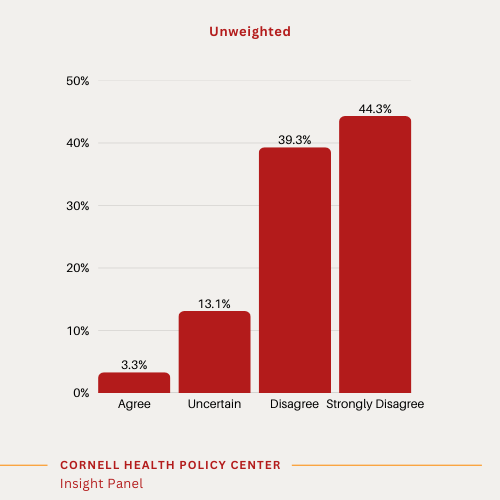
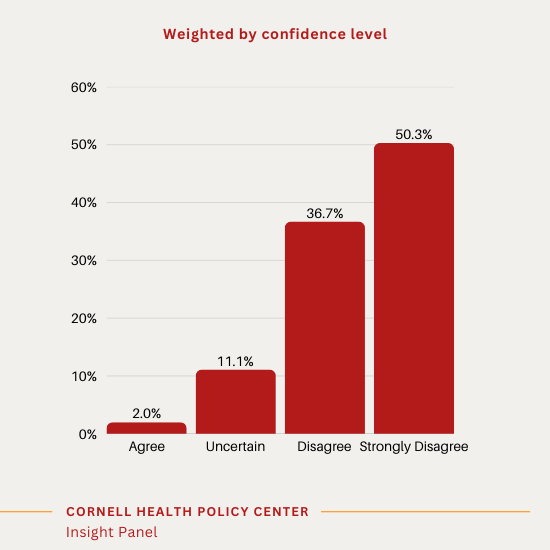
- The vast majority (84%) of survey respondents disagreed or strongly disagreed that Medicaid work requirements introduced by the One Big Beautiful Bill Act (OBBBA) would substantially increase employment among Medicaid-enrolled, working-age adults.
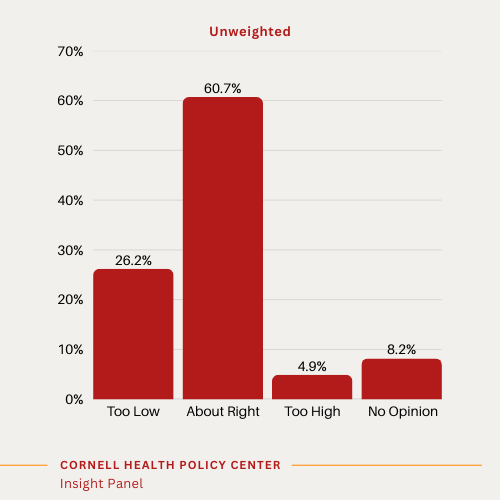
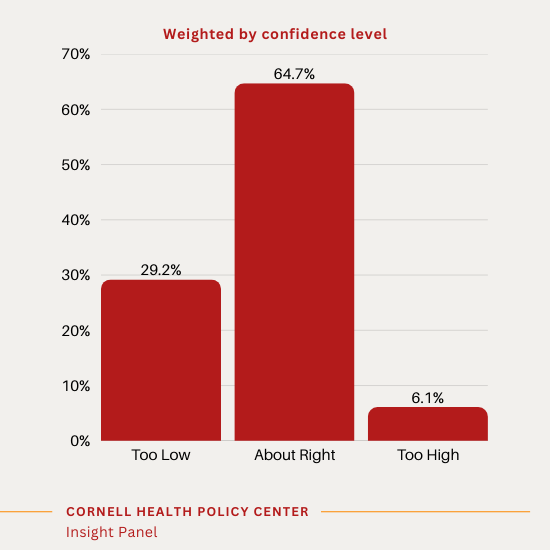
- Most experts (61%) thought that the Congressional Budget Office’s estimate of Medicaid coverage losses related to OBBBA work requirements (5.3 million people by 2034) is about right. Another 26% of respondents felt that CBO’s estimate was too low.
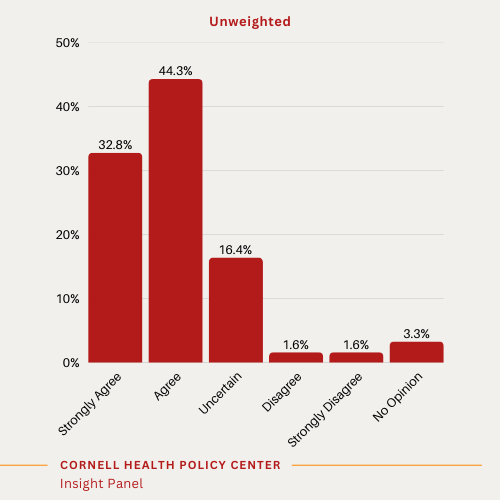
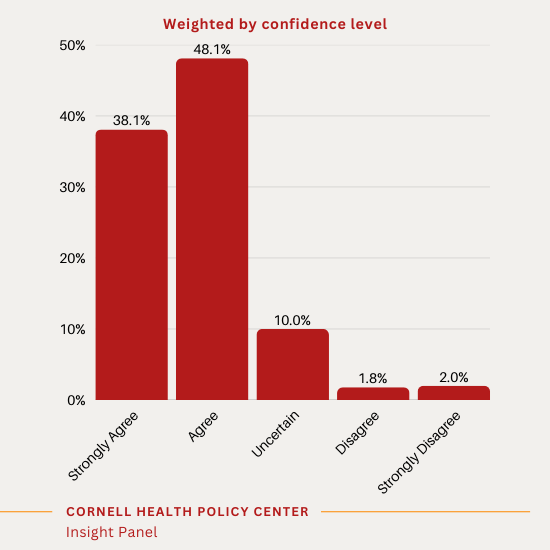
- More than three-quarters of experts (77%) agreed or strongly agreed that more people will lose Medicaid coverage because of challenges submitting documentation to comply with OBBBA work requirements than because they are unemployed.
- A number of respondents said that they based their assessments on evidence from work requirements introduced by Arkansas in 2018. Several noted that, although this data is relevant, it may also be limited in terms of generalizability.
Read the full Health Affairs Forefront summary of results here
Survey Questions
Please note: our surveys will consistently use two modifiers to describe the size of an effect:
- “Substantial”: when an effect is large enough to meaningfully influence policy decisions, program implementation, or outcomes of interest.
- “Measurable”: when the direction of an effect is clear, but the effect may not be sufficiently large to make much of a difference for a given policy, program, or outcome.
The One Big Beautiful Bill Act (OBBBA) introduced several reforms to Medicaid, including work requirements for working-age adults.
Response rate of 95% (61 out of 64 panelists responded)
Question 1: Work requirements introduced by the OBBBA will substantially increase employment rates among Medicaid-enrolled, working-age adults.
a. Strongly Agree
b. Agree
c. Uncertain
d. Disagree
e. Strongly Disagree
f. No Opinion
Question 2: The Congressional Budget Office’s estimate of Medicaid coverage losses related to OBBBA work requirement provisions (5.3 million people by 2034) is likely _____.
a. Too High
b. Too Low
c. About Right
d. No Opinion
Question 3: Most people disenrolled from Medicaid because of the OBBBA’s work requirements will be individuals who lose coverage due to challenges submitting documentation demonstrating that they are compliant or exempt, rather than individuals who lose coverage due to unemployment.
a. Strongly Agree
b. Agree
c. Uncertain
d. Disagree
e. Strongly Disagree
f. No Opinion
Individual Survey Responses
Work requirements introduced by the OBBBA will substantially increase employment rates among Medicaid-enrolled, working-age adults.
| Name | Vote | Confidence | Comments |
|---|
| Margarita Alegria | Disagree | 9 | Most Medicaid participants already work, so it is unlikely that employment will increase in this target population. |
| David Asch | Disagree | 7 | |
| John Ayanian | Disagree | 8 | |
| Peter Bach | Strongly Disagree | 7 | |
| Laurence Baker | Disagree | 8 | |
| David Blumenthal | Strongly Disagree | 9 | |
| Erin Fuse Brown | Disagree | 6 | |
| Melinda Buntin | Disagree | 8 | |
| Michael Cannon | Uncertain | 7 | The proposal may still be worthwhile if it substantially affects other outcomes of interest. |
| Lawrence Casalino | Disagree | 5 | |
| Amitabh Chandra | Disagree | 7 | |
| Lanhee Chen | Uncertain | 5 | |
| Michael Chernew | Disagree | 7 | |
| Janet Currie | Strongly Disagree | 9 | Work requirements have been tried already in several states. They do result in disenrollment, but since many working age people on Medicaid are either disabled or already working, the requirements do not have much effect on enrollment. Rather, by increasing the administrative burden of being enrolled, requiring paper work, and visits to welfare offices during working hours, they tend to disenroll people who are already working. |
| Lesley Curtis | Disagree | 7 | |
| David Cutler | Disagree | 4 | |
| Julie Donohue | Strongly Disagree | 10 | Evidence from work requirements 1115 waiver in Arkansas showed no impact on employment. |
| Joseph Doyle | Disagree | 7 | |
| David Dranove | Uncertain | 4 | |
| Stacie Dusetzina | Strongly Disagree | 8 | The size of the eligible to work but not working population is not large enough to create a substantial change in employment. |
| Liran Einav | Agree | 1 | |
| Jose Escarce | | | Did not answer |
| Elliott Fisher | Strongly Disagree | 9 | The best data comes from the evaluation of Arkansas work requirements which found no effect (NEJM dif and dif evaluation of first year). Several other follow up stuides supported this. |
| Richard Frank | Disagree | 8 | |
| Craig Garthwaite | | | Did not answer |
| Darrell Gaskin | Disagree | 8 | |
| Martin Gaynor | Strongly Disagree | 8 | Evidence does not support the notion that a work requirement will lead to increased employment. |
| Sherry Glied | Strongly Disagree | 7 | |
| David Grabowski | Disagree | 9 | |
| Jonathan Gruber | Strongly Disagree | 9 | |
| Vivian Ho | Uncertain | 10 | Garthwaite et al 2014 QJE study suggests that there will be a substantial rise in employment, but multiple less rigorous studies argue this won’t happen. |
| Jason Hockenberry | | | Did not answer |
| Haiden Huskamp | Strongly Disagree | 9 | |
| Benedic Ippolito | Disagree | 3 | |
| Anupam Jena | Uncertain | 7 | |
| Nancy Keating | Strongly Disagree | 9 | Researchers have examined Medicaid work requirements in Arkansas and found a significant reduction in the proportion of individuals covered by Medicaid but no meaningful change in employment rates. This is because most Medicaid recipients who can work are already working. |
| Aaron Kesselheim | Strongly Disagree | 10 | |
| Jonathan Kolstad | Strongly Disagree | 8 | |
| R Tamara Konetzka | Strongly Disagree | 7 | Limited evidence from states that have implemented work requirements suggests that employment effects will be minimal. |
| Rick Kronick | Disagree | 9 | |
| Valerie Lewis | Strongly Disagree | 8 | |
| Nicole Maestas | Strongly Disagree | 10 | |
| Tom McGuire | Disagree | 6 | |
| Ellen Meara | Strongly Disagree | 9 | Evidence tells us most people who are not exempt from work requirements on Medicaid already work. |
| Ateev Mehrotra | Strongly Disagree | 8 | |
| David Meltzer | Uncertain | 5 | |
| Joseph Newhouse | Strongly Disagree | 7 | Arkansas evidence is strong about little effect, but it is only one state. |
| Sean Nicholson | Strongly Disagree | 7 | |
| Steve Parente | Agree | 8 | It happened in welfore reform in the 1990s. |
| Stephen Patrick | Strongly Disagree | 10 | Many Medicaid enrollees currently work. Evaluations of Medicaid work requirements suggest they do not work. |
| Harold Pollack | Disagree | 6 | The existing studies lead me to be pessimistic. I do believe we should have wide confidence intervals, and much depends on implementation. |
| Daniel Polsky | Disagree | 8 | The evidence to date on work requirements do not find meaningful changes in employment rates. |
| Ninez Ponce | Disagree | 8 | |
| Thomas Rice | Strongly Disagree | 9 | |
| Meredith Rosenthal | Strongly Disagree | 10 | Empirical evidence is clear on this point. |
| Joseph Ross | Strongly Disagree | 9 | |
| Brendan Saloner | Disagree | 7 | My opinion is based on experiences from Arkansas |
| Kosali Simon | Strongly Disagree | 8 | 1) Past research (and CBO report) shows that vast majority already meets the requirement 2) Administrative burdens will mean several who are meeting requirement will be unable to prove and lose coverage (research related to admin burdens, as synthesized by CBO reports including the one this summer) |
| Jon Skinner | Strongly Disagree | 8 | |
| Ben Sommers | Disagree | 7 | |
| Neeraj Sood | Uncertain | 6 | There is evidence from one state only that work requirements do not expand employment . Evidence from welfare reform suggests possibility of employment expansion. |
| David Stevenson | Disagree | 7 | Evidence of implementation to date seems clear, not to mention underlying work demographics of affected populations. |
| Kevin Volpp | Uncertain | 7 | |
| Rachel Werner | Strongly Disagree | 10 | |
The Congressional Budget Office’s estimate of Medicaid coverage losses related to OBBBA work requirement provisions (5.3 million people by 2034) is likely _____.
| Name | Vote | Confidence | Comments |
|---|
| Margarita Alegria | Too Low | 8 | |
| David Asch | No Opinion | 0 | |
| John Ayanian | About Right | 7 | |
| Peter Bach | About Right | 4 | |
| Laurence Baker | About Right | 6 | |
| David Blumenthal | About Right | 4 | The implementation of work requirements will be highly variable across states and depend on the interest of states in preserving access to Medicaid. This social experiment has not been tested in the past. |
| Erin Fuse Brown | About Right | 4 | |
| Melinda Buntin | About Right | 8 | |
| Michael Cannon | Too High | 10 | Medicaid’s matching-grant system determines each state’s grant according to a ratio — the FMAP. Medicaid further gives states substantial flexibility to game that system by tampering with the denominator. My sense is that the CBO does not fully account for the creativity that state policymakers, providers, and consultants bring to that process. |
| Lawrence Casalino | Too Low | 5 | |
| Amitabh Chandra | About Right | 8 | |
| Lanhee Chen | Too Low | 8 | |
| Michael Chernew | About Right | 2 | I have not followed the CBO methods, but generally believe they are a good benchmark |
| Janet Currie | Too Low | 8 | I’m not sure if CBO included effects due to eligible children becoming disenrolled when their parents lose coverage. |
| Lesley Curtis | Too Low | 8 | |
| David Cutler | About Right | 2 | |
| Julie Donohue | Too Low | 6 | Very hard to know given the uncertainty about what guidance CMS will give to states and how states will implement but my sense is that these requirements will be more disruptive than CBO estimates |
| Joseph Doyle | About Right | 6 | |
| David Dranove | About Right | 7 | |
| Stacie Dusetzina | About Right | 8 | Though CBO methods aren’t usually fully explicated, there are prior studies and experiences related to work requirements and administrative burden / enrollment verification that provide strong inputs for models that project coverage losses. |
| Liran Einav | No Opinion | 0 | |
| Jose Escarce | | | Did not answer |
| Elliott Fisher | Too Low | 6 | While other studies suggest greater losses, the much more important point is that strong recent evidence shows a strong effect of Medicaid coverage on mortality. Any increase is likely to be harmful. |
| Richard Frank | About Right | 7 | |
| Craig Garthwaite | | | Did not answer |
| Darrell Gaskin | About Right | 7 | |
| Martin Gaynor | About Right | 6 | |
| Sherry Glied | About Right | 5 | |
| David Grabowski | About Right | 8 | |
| Jonathan Gruber | About Right | 6 | |
| Vivian Ho | About Right | 8 | |
| Jason Hockenberry | | | Did not answer |
| Haiden Huskamp | Too Low | 7 | |
| Benedic Ippolito | Too High | 6 | Financing structure gives states a strong incentive to help workers satisfy community engagement requirements. I expect states will be nontrivially successful in doing so (particularly blue states with large expansion enrollment, like CA and NY). |
| Anupam Jena | No Opinion | 0 | |
| Nancy Keating | About Right | 6 | Hard to know for sure-a lot will depend on how states implement the work requirement reporting procedures. If these are complex it could be many more who lose Medicaid coverage. |
| Aaron Kesselheim | Too Low | 7 | |
| Jonathan Kolstad | About Right | 5 | |
| R Tamara Konetzka | About Right | 7 | Good estimate based on limited evidence, but with some uncertainty. |
| Rick Kronick | No Opinion | 0 | |
| Valerie Lewis | About Right | 5 | I don’t know the literature on this that well, so I expect there will be large losses, but I don’t personally have an intuition as to the extent. I generally trust CBO for these type of estimates. |
| Nicole Maestas | Too Low | 5 | |
| Tom McGuire | About Right | 6 | |
| Ellen Meara | About Right | 7 | The estimate is likely a lower bound, but a reasonable one based on evidence from Arkansas work requirements. The OBBBA has several features that could add to administrative burden, and therefore some estimates of lost Medicaid are higher. The answer is – it depends how states respond… |
| Ateev Mehrotra | About Right | 3 | This one is tough. Given experience of Arkansas, I hope that many states will make it logistically easier for Medicaid beneficiaries to demonstrate that they are working or are exempt. |
| David Meltzer | No Opinion | 0 | |
| Joseph Newhouse | About Right | 5 | As a point estimate it is probably near an expected value but the uncertainty is large. |
| Sean Nicholson | About Right | 8 | |
| Steve Parente | Too Low | 6 | |
| Stephen Patrick | About Right | 6 | |
| Harold Pollack | About Right | 6 | Same comment–wide confidence interval |
| Daniel Polsky | About Right | 7 | The CBO brings together evidence for projections better than any other source. I expect there is a wide confidence band around these projections, but I have no basis for providing an opinion they are either too high or too low. |
| Ninez Ponce | Too Low | 8 | |
| Thomas Rice | About Right | 6 | |
| Meredith Rosenthal | About Right | 8 | I am not sure how much to trust CBO in the current administration — ordinarily I would have said that they use the best available evidence for these estimates. |
| Joseph Ross | Too Low | 5 | |
| Brendan Saloner | About Right | 6 | |
| Kosali Simon | About Right* | 8* | |
| Jon Skinner | About Right | 6 | |
| Ben Sommers | Too Low | 5 | Really hard to know what states will be able to do on this timeframe and how aggressively they will aim to use ex parte renewal to protect coverage |
| Neeraj Sood | Too High | 5 | Many assumptions and scant evidence base. Depends on how states implement |
| David Stevenson | About Right | 5 | |
| Kevin Volpp | About Right | 7 | |
| Rachel Werner | Too Low | 8 | |
Most people disenrolled from Medicaid because of the OBBBA’s work requirements will be individuals who lose coverage due to challenges submitting documentation demonstrating that they are compliant or exempt, rather than individuals who lose coverage due to unemployment.
| Name | Vote | Confidence | Comments |
|---|
| Margarita Alegria | Agree | 8 | |
| David Asch | Agree | 6 | |
| John Ayanian | Strongly Agree | 9 | |
| Peter Bach | Agree | 7 | |
| Laurence Baker | Agree | 8 | |
| David Blumenthal | Agree | 8 | |
| Erin Fuse Brown | Agree | 8 | |
| Melinda Buntin | Strongly Agree | 8 | |
| Michael Cannon | Uncertain* | 7* | What is more relevant is that they are likely to be the healthiest of the Medicaid-expansion enrollees, which further suggests that the health impact of those coverage losses is likely to be small or zero. |
| Lawrence Casalino | Agree | 5 | |
| Amitabh Chandra | Uncertain | 7 | |
| Lanhee Chen | Uncertain | 5 | |
| Michael Chernew | Agree | 6 | |
| Janet Currie | Agree | 8 | |
| Lesley Curtis | Strongly Agree | 10 | |
| David Cutler | Agree | 6 | |
| Julie Donohue | Strongly Agree | 8 | |
| Joseph Doyle | Agree | 9 | |
| David Dranove | No Opinion | 0 | |
| Stacie Dusetzina | Agree | 8 | Prior research and the extent of administrative burden and coverage losses during redeterminations will be more impactful. |
| Liran Einav | Uncertain | 1 | |
| Jose Escarce | | | Did not answer |
| Elliott Fisher | Agree | 9 | |
| Richard Frank | Agree | 8 | |
| Craig Garthwaite | | | Did not answer |
| Darrell Gaskin | Agree | 7 | |
| Martin Gaynor | Uncertain | 5 | |
| Sherry Glied | Agree | 6 | |
| David Grabowski | Uncertain | 5 | |
| Jonathan Gruber | Uncertain | 1 | |
| Vivian Ho | Strongly Agree | 10 | State management of Medicaid has become a bureaucracy nightmare. |
| Jason Hockenberry | | | Did not answer |
| Haiden Huskamp | Uncertain | 3 | |
| Benedic Ippolito | Uncertain | 1 | Agree this is possible, but I am uncertain about how representative existing evidence (e.g., Arkansas) will be of other states. |
| Anupam Jena | Agree | 7 | |
| Nancy Keating | Strongly Agree | 9 | Administrative barriers and confusion about reporting requrements were the biggest driver of uninsurance in the Arkansas study. |
| Aaron Kesselheim | Agree | 10 | This is a feature, not a bug. |
| Jonathan Kolstad | Disagree | 7 | |
| R Tamara Konetzka | Agree | 7 | This is what the available evidence suggests. |
| Rick Kronick | Agree | 8 | |
| Valerie Lewis | Agree* | 5* | |
| Nicole Maestas | Strongly Agree | 8 | |
| Tom McGuire | Agree | 7 | |
| Ellen Meara | Strongly Agree | 10 | again, the evidence is very strong here and most people subject to requirements already work! |
| Ateev Mehrotra | Strongly Agree | 8 | |
| David Meltzer | No Opinion | 0 | |
| Joseph Newhouse | Strongly Agree | 7 | This overlaps with question 1; again the Arkansas evidence is strong, but it is only one state. |
| Sean Nicholson | Agree | 6 | |
| Steve Parente | Strongly Disagree | 8 | Most of the population in question have government-issued phones or access to a smartphone. This will be an app affirmation process. |
| Stephen Patrick | Strongly Agree | 9 | As evidenced by recent Medicaid redetermination, these structural barriers frequently result in lower enrollment and/difficulty enrolling. |
| Harold Pollack | Agree | 5 | An unwise policy. Many uncertainties and calculated risks. The only upside to the work requirement is that this may provide a politically dignified path for some Republican officials to support Medicaid. |
| Daniel Polsky | Agree | 5 | This statement would be consistent with past experiences with work requirements. It is hard to be highly confident in this future projection given that the administration of this massive change has yet to be set in regulation. |
| Ninez Ponce | Agree | 7 | |
| Thomas Rice | Strongly Agree | 10 | |
| Meredith Rosenthal | Strongly Agree | 10 | Again, the empirical evidence is clear. |
| Joseph Ross | Strongly Agree | 9 | |
| Brendan Saloner | Agree | 8 | |
| Kosali Simon | Strongly Agree* | 8* | |
| Jon Skinner | Agree | 5 | |
| Ben Sommers | Strongly Agree | 8 | Prior literature is pretty good on this topic |
| Neeraj Sood | Uncertain | 6 | Evidence from 1 state only. Depends on implementation |
| David Stevenson | Strongly Agree | 9 | History is a guide to my answer. |
| Kevin Volpp | Uncertain | 6 | i think both will be reasons people lose coverage, not sure relative magnitude |
| Rachel Werner | Strongly Agree | 10 | |
* This response was captured after analysis was completed and is not included in the aggregate survey results.
Meet our panel of experts